


Helminthiasis is a disease in which the human body is infected with parasites.This problem often affects children (80%), but adults can also contract the virus.Symptoms of the disease may vary depending on the method of penetration and the number of parasites.
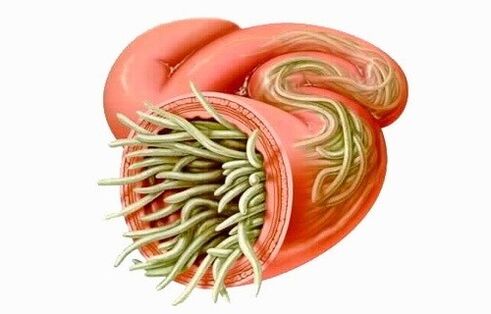
Helminthiasis is a disease in which infection with worms occurs.
Description of the disease
Parasitic worms (worms, helminths) are individuals that take root almost everywhere.The most common types of worms that infect the human body are pinworms, tapeworms and roundworms.Any infected adult or child is a carrier of more than 400 different types of helminths, each of which has several classes.Therefore, only the attending physician can determine which worm parasites in a particular organism and prescribe the exact treatment.
They are most often located in the intestine, but can affect other areas as well.The worms affect the brain and eyes, causing allergies and metabolic disorders.Their prevalence is influenced by living conditions and climate.Therefore, in European countries, in urban areas, the rate of the disease is much lower.
The most dangerous are the larvae of worms, as they move throughout the body, causing further damage to many important organs.Adult parasites settle in one place and affect only a certain location.Intestinal helminthiases do not live permanently in the human body and, depending on the type, sooner or later die.
However, this does not mean that the problem does not need to be solved.Both the parasites themselves and their decay products are dangerous.Worms worsen the general condition of the human body, reduce immunity and aggravate chronic diseases in the patient.In addition, helminths in the body reduce the effectiveness of various types of vaccines and drugs.The most dangerous signs of helminthiasis are for the heart and eyes.
Irritating factors of the disease
Most often, the carrier of helminths is a patient (more than half of cases of infection): female parasites come out of the anal folds and lay eggs there (about 5 thousand eggs per female).The infected person feels itchy, scratches the affected area and spreads the parasites further: to items in their wardrobe and to things they touch during the day.
Worms enter the body through food, but there are other routes of transmission: through the skin (dust particles with the virus remain under the nails) or through airborne droplets.That is why patients who do not follow the necessary hygiene rules, eat dirty fruits and vegetables and drink non-distilled tap water run the risk of contracting this disease.

You can get worm infection by drinking tap water.
Therefore, helminthiasis most often affects people living in a private house, pet owners, gourmets who prefer medium roasted, smoked and sushi meat.Frequent carriers of parasites are dogs and cats (both domestic and stray).This parasite is called “taxacara” and can penetrate another organism;the risk of infection is especially high for a person with a weak immune system.The following varieties are distinguished:
- Contact.Transmitted from person to person, they represent the most common type of infection.
- Geohelminthiasis.Transmitted through soil or water;in some cases infection through a sick animal is possible.The vector of infection contains eggs of adult worms, which reach humans through the feces of an animal, insect or person.People who work the land are at risk, especially without gloves.
- Biohelminthiasis.Worms that enter through lightly fried foods: fish or meat.
- Worms that enter through insect bites (most often mosquitoes).
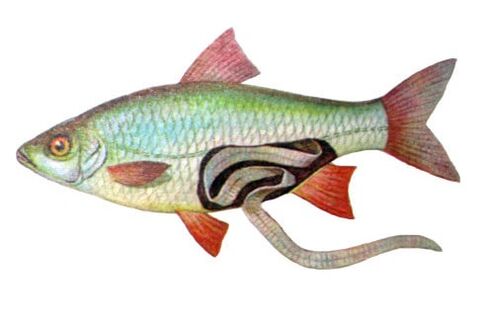
Worms can enter the body along with food without heat treatment.
Forms of the disease
Depending on the location, the following types are distinguished:
- luminal – located in the intestine;
- individuals of the hepatobiliary system;
- affecting the lungs;
- penetrating fabric;
- ophthalmic helminth infections.
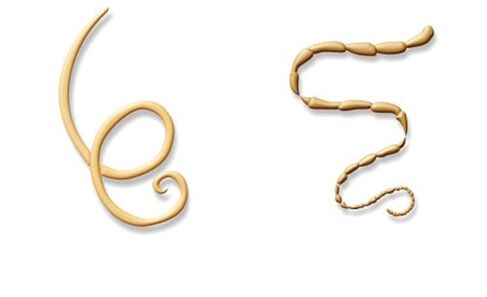
Among the most common types of worms are roundworms and tapeworms.
The most common types of helminthiasis:
- Nematodes.
- Pinworms.
- Whipworms.
- Wide ribbon.
- Trichinella.
- Bull tapeworm.
The first variety enters the intestine through the mouth and from there into the lymph.Moving to the lungs and other organs, roundworms cause fever, weakness and cough.The virus enters the stomach, where an adult is formed.The patient develops allergies and the infected person suddenly loses weight.Patients often come to hospital with other ailments (for example, pneumonia, which has similar symptoms).
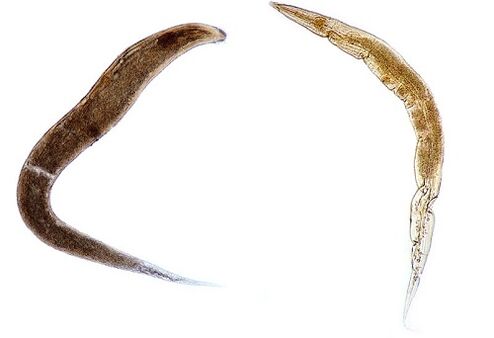
Pinworms are often located in the large intestine, where they grow within 2 weeks.They seep through unwashed food, dirty hands and soil.The most obvious symptom is anal itching, which worsens at night.If there is a large number of worms, the patient is constantly bothered by itching.
Whipworm enters through food.The infected person experiences abdominal pain, lack of appetite and anemia.Often, when a whipworm penetrates, the infected person is prescribed the wrong therapy and is offered removal of acute appendicitis.
The fourth variety settles in shrimp or freshwater fish and is then located in the human body via an infected freshwater fish or its eggs.The patient feels constant stomach pain.
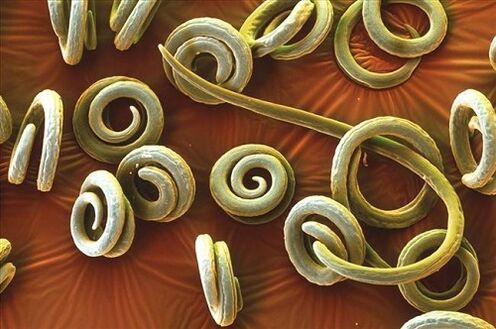
Trichinella enters through improperly heat-treated meat, which contains the egg of the parasite.The muscles of the face, arms, legs and joints are affected.First, a person feels nausea, suffers from diarrhea, after a few days the temperature rises, the face swells, and a rash appears on the body.After a month, the larvae die due to the active work of the body.
Bovine tapeworms enter humans through pork or beef.This has a negative effect on the gastrointestinal tract, as it ceases to function normally (intestinal and digestive pathologies).
Signs of illness
Symptoms have 2 stages of development.The acute phase lasts about 2 weeks, when the parasite develops there.The symptoms are largely similar, which is absolutely independent of the type of worm.This form of the disease is characterized by the following symptoms:
- General symptoms.They appear several weeks after infection: the temperature rises, a rash forms, the face swells, severe weight loss, paleness and itching are observed.Breathing problems are common in children.
- Malfunctions of the gastrointestinal tract.Diarrhea suddenly gives way to constipation, the patient is diagnosed with vomiting and abdominal pain near the navel and possible active gas formation.These symptoms can be mild or severe depending on the type of parasite.
- Nervous system problems.Parasites release toxic substances.The more of them in the body, the more actively they work.The patient experiences frequent headaches, nausea and dizziness.Also, symptoms develop at a high temperature, as a result of which the body and joints hurt.The patient gets tired quickly, cannot sleep enough and rest adequately.Due to lack of sleep, irritability appears and work productivity decreases.
- Allergy.Symptoms of rash due to helminthiasis are similar to urticaria or allergic rhinitis.The skin begins to peel, nails and hair become thin and brittle.Another distinctive feature is cracked heels.
- Poor immunity.Helminthiasis significantly reduces immunity and a person gets sick more often.Some internal organs may be damaged.

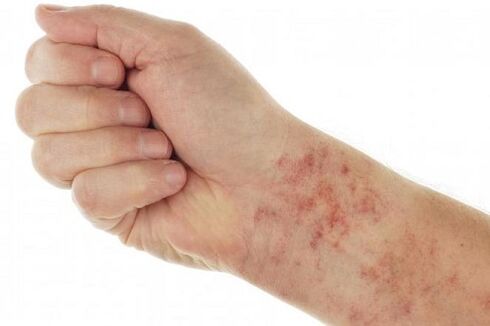
Symptoms in the next phase, the chronic phase, are more varied.Here disorders of different organs will be visible depending on the amount, location and type of worm.If there are few helminths in the body, they do not manifest themselves in any way;various symptoms are evident only when the worms are actively breeding.
Diagnosis of the disease
The diagnosis of helminthiasis consists of a general blood test, in which eosinophils (binding foreign proteins in the blood) are elevated.In addition, urine and feces are tested.You may need to repeat the test after 3 days, as the worms are not always visible.In some cases, further testing for helminth infections is necessary.For this purpose, bile, sputum and muscle tissue are examined.

During laboratory diagnostics, fragments of worm larvae or eggs are looked for in the object of analysis.If symptoms are more chaotic, additional blood tests may be ordered.Other means of diagnosis: ultrasound, radiography, endoscopy and computed tomography.
Worms will absorb foods that enter the human body, so laboratory tests will show a significant lack of vitamins and minerals.Microscopic examination is prescribed if the presence of roundworms or pinworms is suspected.If symptoms indicate problems with the digestive system, fibrogastroduodenoscopy is prescribed.
Treatment of the disease
All complex treatments are prescribed only by the attending physician, since it is necessary not only to destroy the parasites themselves, but also all the consequences that they caused.If a certain type of worm is detected, anthelmintic drugs are prescribed.In most cases treatment consists of a single dose of the drug, but in some cases it is possible to take the drug again after a short period of time.
Additionally, the following medications may be prescribed:
- Antihistamines (antiallergic drugs), which will remove all harmful substances from the body and normalize the condition of the skin.
- If the level of hemoglobin or red blood cells in your blood is low, you will be prescribed medications containing iron, B vitamins, or folic acid.
- Additionally, treatment will consist of taking vitamins and following a specialized low-carb diet.
- The room where the infected person lives, as well as his personal belongings, are carefully treated.
- The diagnosis of helminthiasis is indicated for all family members or people who interact directly with the patient.
- The treatment requires nail care.They should be cut short and cleaned thoroughly.
- In more advanced cases, hormonal drugs and drugs with a high potassium content are prescribed.
Also, the treatment may consist of folk recipes.Natural plants also have anthelmintic properties.For example, juice of celandine and elecampane.Vegetable (carrot) juices will also help eliminate the symptoms of helminthiasis.Pomegranate, pumpkin seeds, mint or garlic are suitable for treatment.
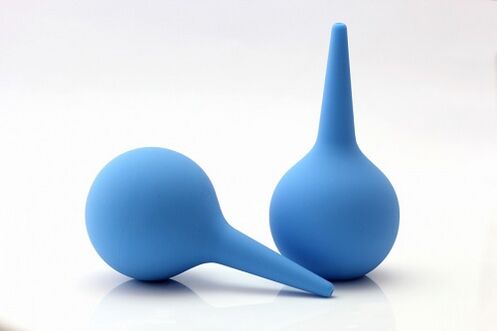
Enemas with herbal decoctions help eliminate helminthiasis.
Wormwood decoction can be used as an enema or internally.Folk remedies are often used in combination with saline laxatives.Treatment of helminthiasis only with medicinal methods is unacceptable, however, in addition to the main one or as a means of prevention, such natural preparations will benefit the body.
Treatment of children is often carried out in a hospital setting, since in them the disease is more serious and lasts a long time.When choosing drugs to treat a child, the doctor often changes them along the way, since the initial drugs will not always be effective for the child's body.
Disease prevention
Prevention of helminthiasis is quite simple and does not require much effort.After each work with the earth, wash your hands and also treat your nails, as this is how parasites most often enter the body.You should always wash your hands before eating anything, after going out and after using a public toilet.Also, sometimes you can use hand sanitizer.

Everything must be worked with care and scalded with boiling water.Care must be taken to protect food from flies and other insects, as insects often carry the infection on their wings.This is especially true in spring and summer.
You should always wash your pets after walking.After a long stay of the animal on the street (for example, in the summer season in a summer cottage), the animal's fur is treated with specialized antiparasitic agents.All pet vaccinations must be carried out on time.
You should drink only boiled or filtered water and avoid water from wells or open tanks.Sources may contain intestinal helminth infections.Individual dishes, towels and personal hygiene items are provided for each family member.Fry meat and fish well before eating them.Sushi lovers can try to find a dish that does not contain raw product.

A preventive course of anthelmintic drugs should be administered once every 6 months.
It is possible to carry out pharmacological prophylaxis twice a year: 1 tablet of an antiviral drug once a day after meals for 3 days.If the child is small, parents should consult the pediatrician whether he can take such drugs.